Copyleaks AI & Plagiarism Detector
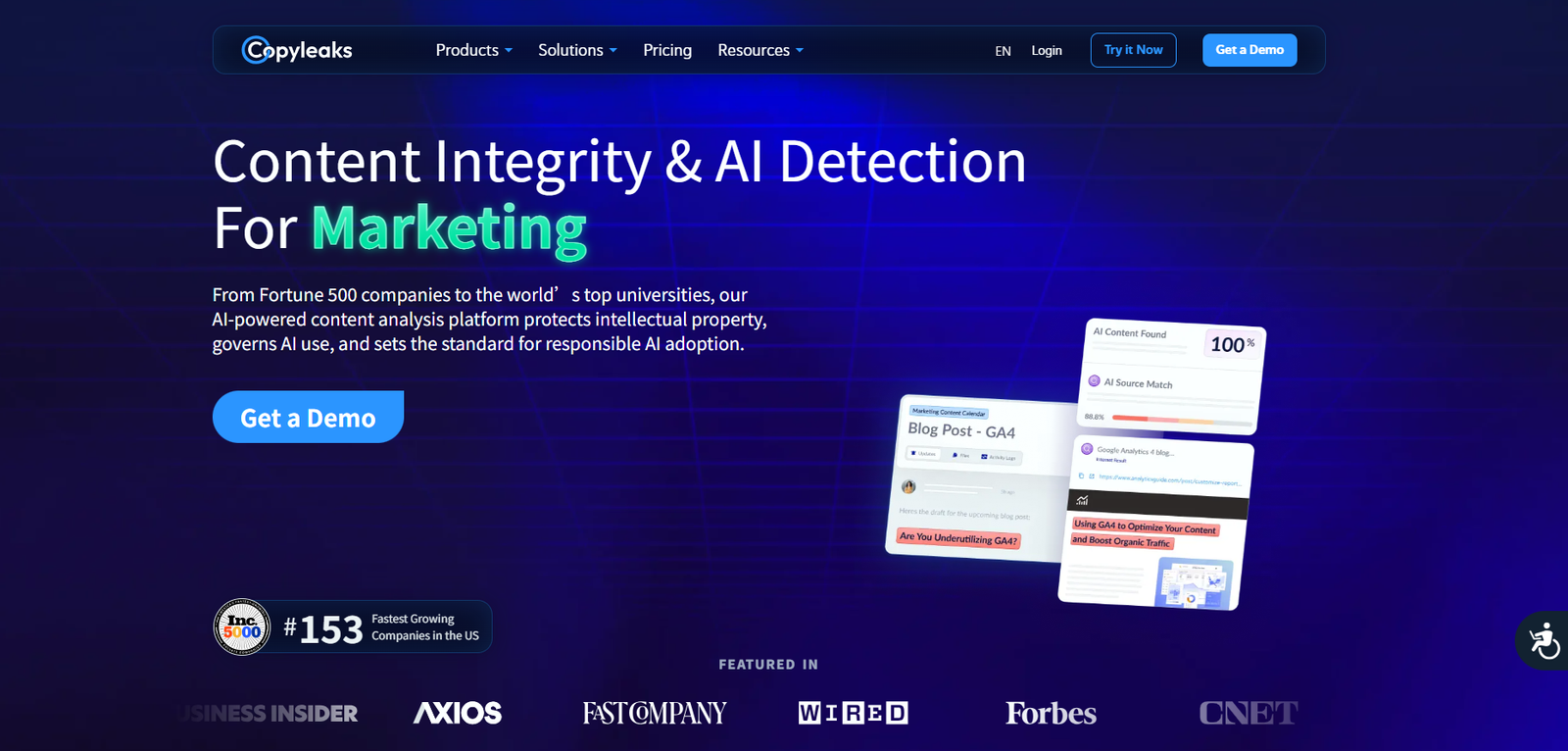
Copyleaks is most relevant when your workflow needs AI analysis and source matching together. Evaluate the reports and shared credit accounting before buying a plan based on its headline word allowance.
Source checked October 19, 2026. Based on published product and research sources.
Two checks, different questions
Copyleaks combines AI-origin analysis and plagiarism matching. A similarity match concerns overlapping sources; an AI classification concerns likely generation. Neither result automatically establishes ownership or intent. It is a candidate for teams that need both workflows in one reporting environment.
Current pricing and allowances
The official pricing page lists Personal monthly at $16.99 with 100 unified credits, covering up to 25,000 words or 100 images. These are alternative uses of a shared allowance, not two additive pools. Personal annual is $167.88 billed yearly, displayed as $13.99/month, with 1,200 credits and up to 300,000 words or 1,200 images. Do not read the annual total as a monthly allocation. Check the selected billing option and credit renewal terms at checkout.
Coverage and workflow
The same page lists AI text detection in 30+ languages and plagiarism detection in 100+ languages, alongside a unified report, batch uploads, browser extensions and Google Docs support. Language coverage differs by check; confirm your actual language before adopting it. A “Start free” button does not establish a permanent unlimited free tier.
Compare before choosing
Free AI detectors: limits, privacy and false positives · GPTZero vs ZeroGPT · All AI content detectors
Interpret similarity and AI signals separately
A document can be human-written and contain unattributed copied text. It can also be generated without matching a published source. A third document may be properly quoted and have a high similarity result. These are distinct situations; a combined report is useful only if the reviewer can distinguish them.
| Illustrative situation | Review action |
|---|---|
| High source overlap in a bibliography | Inspect citation and exclusion settings before treating it as copied prose. |
| AI flag on a standard methods paragraph | Compare drafting history and the source of the wording. |
| No source match but unsupported factual claims | Fact-check the claims; no match does not establish truth. |
| Copied text with no AI flag | Resolve attribution; AI detection is not the relevant test. |
Turn a credit allowance into a workload estimate
Plan around your actual document lengths and selected scan options. The Personal monthly allowance currently advertised corresponds to 25,000 words, but the charge for a particular scan should be confirmed in the product. Do not assume AI and plagiarism modes, repeat scans, exclusions or images all consume the same amount.
Planning example, not a billing promise: a workload of 30 documents at 800 words is 24,000 input words. That leaves only 1,000 words under a 25,000-word headline allowance before any repeat work. A second complete pass would raise total input to 48,000 words. Check the product’s actual credit calculation before treating this arithmetic as a purchase recommendation.
The critical comparison is cost per completed review, including staff time and rechecks. A cheaper plan can become expensive if many reports need manual clarification; a larger plan can be wasteful when the workload is seasonal. Record both scan usage and review minutes during a short pilot.
Institutional requirements are a separate purchase question
The pricing FAQ directs API and LMS use toward custom education or enterprise arrangements. Do not assume an individual subscription includes institutional permissions, roster integration or the retention terms your organization requires. Confirm seats, access control, where documents are indexed and how an administrator exports or deletes data.
Read the privacy policy and the settings for the actual service you purchase. In a multi-check workflow, distinguish personal scan history, an organization repository and any wider sharing mechanism. This review has not validated your default account settings or a data-processing agreement.
How to read Copyleaks accuracy claims
The vendor publishes an AI detector testing methodology. Evaluate the sample labels, language and genre, threshold, model versions and independent reproducibility. A published methodology is more informative than an isolated percentage, but it does not establish the same result on your documents. Test human writing as carefully as generated writing; otherwise a trial can look successful while missing the cost of false accusations.
Which alternative fits which gap?
If you need only occasional AI-origin review, compare Pangram’s limited free account before committing to a larger workflow. If author drafting context matters most, inspect GPTZero. If a quick public check is sufficient, inspect ZeroGPT, while keeping its field size separate from a verified subscription allowance.
Download our blank detector evaluation worksheet (CSV) and purchase checklist. They contain no detector results. Fill them with your own authorized samples.
Frequently asked questions
Is $13.99 a monthly payment?
The advertised $13.99 figure is a monthly equivalent for an annual commitment. The annual amount is billed yearly; a month-to-month subscription is a different offer. Confirm tax, currency and the selected renewal period at checkout.
Are text and image allowances additive?
The pricing page presents alternative uses of unified credits. Do not budget for the full advertised text allowance plus the full image allowance as if they were independent pools. Use the usage preview or ask support how your mixed workload is counted.
Does one language count apply to every check?
No. The published AI and plagiarism language counts differ. Confirm the exact language and feature you need, then test representative writing in that language. A broad platform language claim does not guarantee equal detection performance everywhere.
Can a clean report certify an article as original and accurate?
No. A clean result does not establish permission, factual correctness or absence of all copied material. Check quotations, primary sources and the drafting history as appropriate to the job.